Exocom Link-1

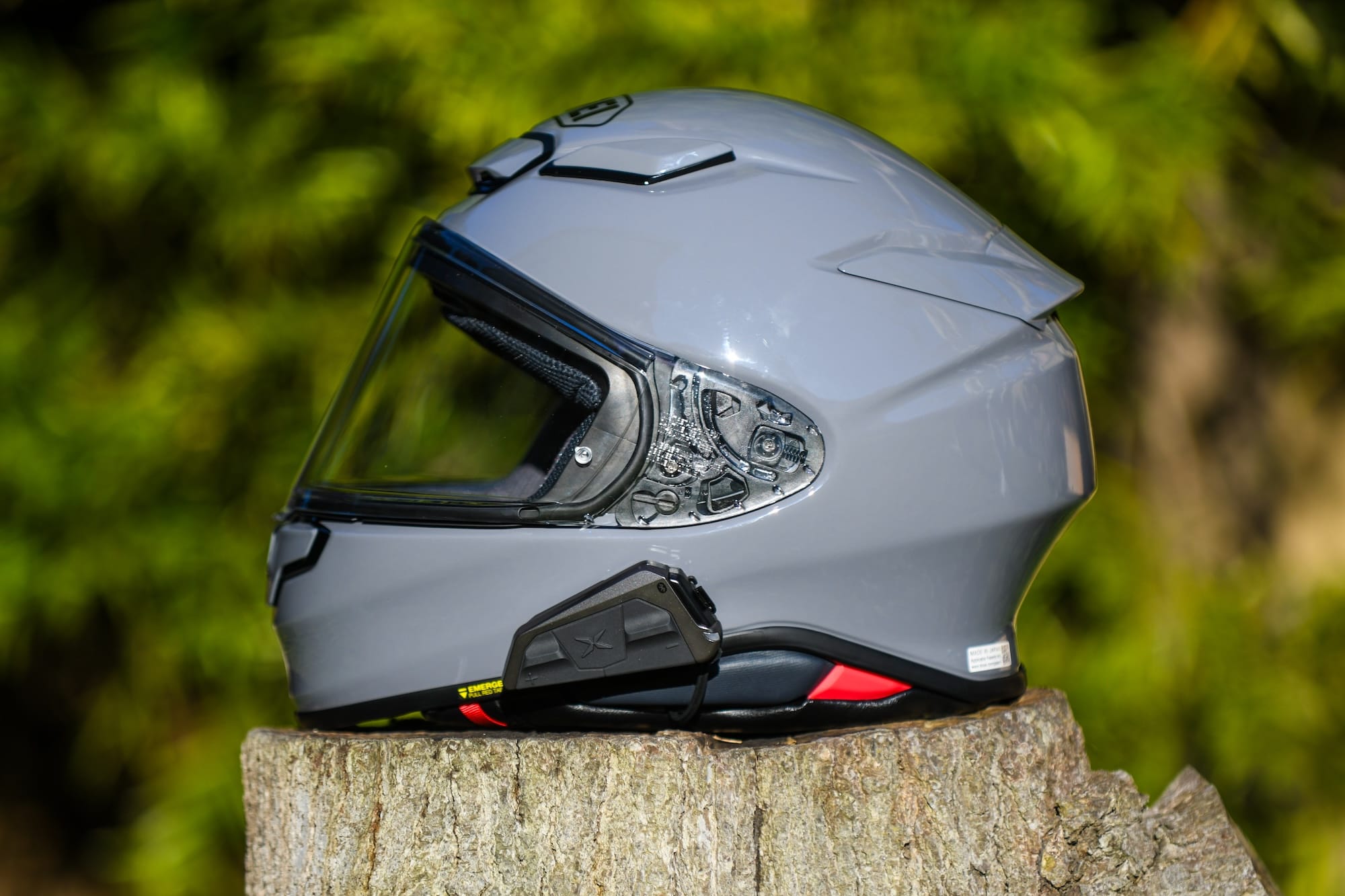
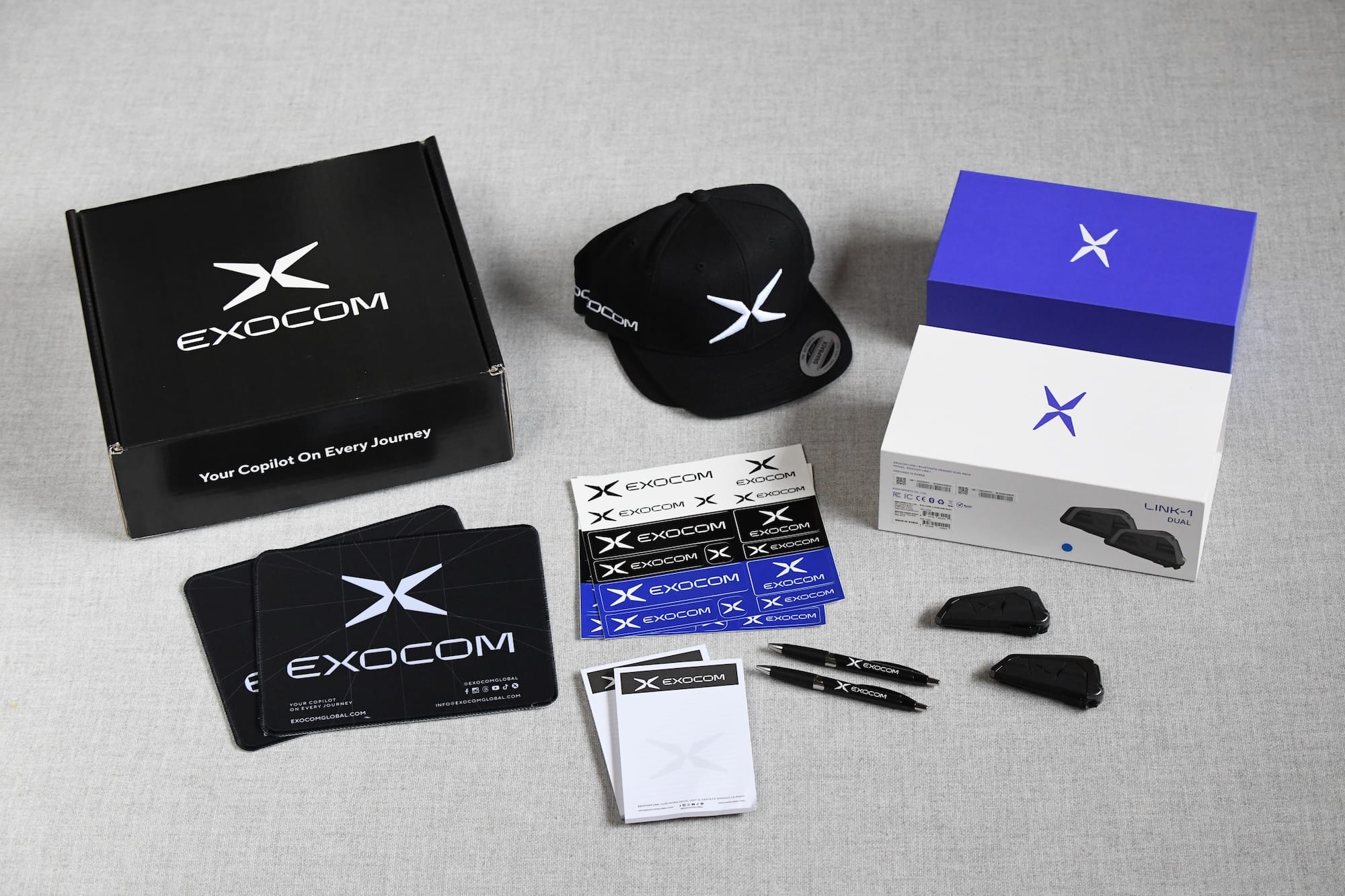
Exocom has arrived as a new brand player offering universal helmet communicator units. The brand is a branch of Kido Sports that also owns the popular helmet and gear manufacturer ScorpionExo. Exocom’s flagship product is the Link-1. Its straightforward installation procedure is similar to most other helmet comm systems, except for the mount.
A small twist-lock adapter is included with the accessory kit, designed to work exclusively with latest-generation ScorpionExo helmets featuring the communication system port. To allow for compatibility with other helmets, both a universal clamp-style mount and an adhesive adapter for the audio base are included. The uniquely flexible adhesive mount requires a simple “shaping” procedure to help approximate the curvature of the helmet shell and better ensure solid adhesion.
Simple Pairing
Once installed, pairing the two units was a simple and quick process by virtue of Exocom’s unique NFC pairing technology. Once the master rider has enabled Easy Pairing in the Exocom app, additional riders can be added to the NFC app list simply by holding your phone near each additional Link-1 unit. No more pressing and holding various combinations of buttons and hoping things link up.
Pairing the Exocom app to the Link-1 was arguably one of the most seamless procedures I’ve tried with any device. Prior to downloading the app, I’d already paired the Link-1 to my phone directly via Bluetooth for making calls. Once I downloaded the app, I was able to explore features such as assigning tasks to the Quick Access Button, setting up an NFC list, and changing the Multi-Device Audio settings. The latter offers separate control of background music volume while maintaining voice communication with other connected riders. Simply logging into my newly created Exocom account automatically paired the app to the Link-1 and, in my case, notified me there was a firmware update available. One click, and the unit was updated and synced with the app.
While I only used the Link-1 with one other rider, it can connect with up to four other units. Fortunately, your riding group doesn’t necessarily need to be running Exocom only. Over the course of my tests, I connected the Link-1 with Cardo, Sena, and TrailTech communicators. While pairing procedures and functionality varied with each brand, all the connections worked… Mostly. Cross-brand pairing was possible via Bluetooth, but connection stability was sometimes inconsistent. On a few occasions, the connection would inexplicably drop, and reconnecting would sometimes require multiple attempts.
Using the two Exocoms as a pair, reconnecting was always quick and easy. Via the Link-1’s Bluetooth 5.3 connection, after performing an initial pairing, the units would subsequently reconnect with a single press of the center button. Bluetooth’s 5.3 version has reduced device battery consumption and enhanced connectivity via advanced channel selection and power management compared to previous versions.
All About That Bass (and Treble)
Unlike Sena and its Harman Kardon logos or Cardo’s partnership with JBL, the 40mm HD speakers included with Exocom’s helmet kit have no visible co-branding with an audio company. Partnering with established players in the audio world bodes well for sound quality, and it begs the question of how the Link-1’s non-branded speakers stack up in comparison. Harman International Industries does supply the speakers for Exocom, but the company owns a dizzying number of brands, including both Harman Kardon and JBL, as well as AKG, Mark Levinson, Infinity, and so on. Who exactly makes the speakers for the Link-1 isn’t clearly stated on the website or on the product.
At their most basic, the Link-1’s speakers pass the test for volume and lack of distortion, even when cranked to maximum. Evaluating nuances of sound quality in a motorcycle helmet is a bit like testing perfumes while getting tear gassed. You can develop an opinion, but there are too many variables for me to feel it could be accurate in a broader scope.
I can say there were perceivable differences in things like bass response and overall clarity between the three communicator brands I tested, but each was mounted in a different helmet. Some tests were aboard a smooth and subdued Ducati, while for others I was on a KTM 990 with Leo Vince pipes that you could probably hear from wherever you are reading this. In the end, I was pleased with the Exocom’s sound quality. However, I’m hesitant to offer an opinion about how the synths panning around in Tame Impala’s “The Moment” will compare to your tube-driven McIntosh system at home or your phone.

Voice Control and Special Buttons
Among the voice command features that I tested were Play/Stop Music, Volume Up/Down, Next/Previous Track, Mute Microphone, Answer Call, End Intercom, and Check Battery. It’s nice to know how much comm time you have left without needing to turn the unit on or off, or check the app. Whenever you open the app and switch on the communicator, the home screen displays both battery percentage and time remaining for the claimed 14-hour battery life.
One feature unique to the Link-1 is the quick access button. Positioned at the bottom-rear of the unit, there’s no hunting around to find this button while riding. It’s programmable to serve three functions: Voice Assistant (that is, Siri or Android equivalent), Speed Dial, or Last Number Redial.
An IP-58 rating means the Exocom Link-1 is water- and dustproof in virtually any motorcycle-related context. Based on rating specs, a Dakar competitor navigating days of fesh-fesh or Robbie Maddison duck diving his KTM 450 SX-F at Teahupo’o might experience issues, but for the rest of us, the Link-1 is solid. The winter of 2025-2026 brought record rainfall to Southern California, and I spent many high- and low-speed miles riding with the Link-1 through downpours without any problem.
Tackling something as complex and nuanced as designing a new helmet communicator system and an associated mobile app is a challenge, particularly when competing with long-established players like Cardo and Sena. Out of the gate, Exocom has created an impressive product with a robust and largely intuitive feature set, and it’s done so at a competitive price point. Coming in at $539, the Link-1 Dual costs $261 less than a Cardo Packtalk Duo. It’s worth a hard look to see if it might be the comm solution you’ve been looking for.
Exocom Link-1
$296.95 (single unit)
$538.95 (dual)